Firearm Laser Engraving: What to Know Before Your Project
Considering firearm laser engraving? Learn what to consider about design, placement, materials, and project planning from Precise Arms in Bellevue, WA.
Firearm laser engraving can be used for personalization, identification, markings, design elements, or other project-specific purposes. Whether you are adding a discreet marking to a carry piece, personalizing a match rifle, or creating a distinctive visual design across a custom build, the right approach depends on the firearm, the material, the intended result, and the project's legal and practical requirements.
Because every firearm is engineered with specific tolerances, surface treatments, and metal compositions, laser engraving is not a one-size-fits-all process. Understanding what to evaluate beforehand helps ensure the finished piece meets your expectations for durability, contrast, and visual refinement.
What Is Firearm Laser Engraving?
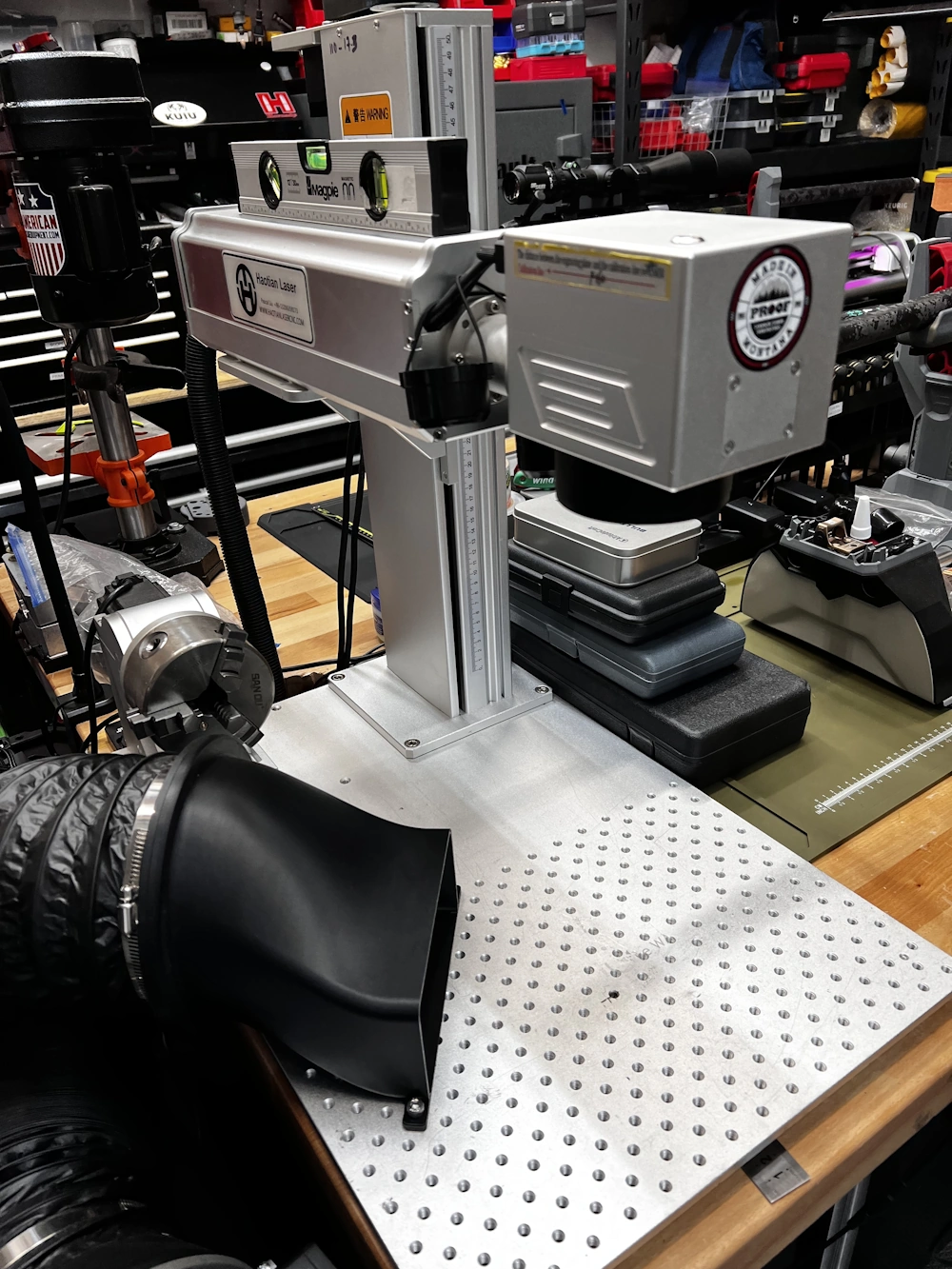
In general terms, firearm laser engraving uses focused laser equipment to mark, etch, or engrave a surface with extreme precision. Rather than cutting with mechanical bits or applying chemical stencils, a computer-controlled laser beam interacts directly with the surface material or coating.
Depending on the equipment settings, material type, and desired outcome, the process can produce surface annealing, color changing, deep marking, or clean material removal. This allows for clean, sharp, repeatable designs that would be difficult or impossible to produce by hand, all without exerting mechanical stress or clamping distortion on precision firearm components.
What Can Be Considered for Engraving?
Laser engraving offers tremendous versatility across a wide variety of firearm projects. Common applications evaluated by our shop include:
- Firearm Identification or Personalization: Meaningful dates, initials, names, family crests, or call signs placed on receivers, slides, or small parts.
- Selected Design Elements: Custom scrollwork, geometric textures, topographic patterns, or decorative accents tailored to complement the firearm's lines.
- Names, Logos, or Markings: Organization emblems, unit insignias, company logos, or commemorative text when legally and aesthetically appropriate.
- Pistol, Rifle, or Other Projects: Slide engraving, receiver accents, barrel markings, magazine plates, or matching accessory parts.
It is important to emphasize that not every firearm, material, location, design, or requested project is suitable for laser engraving. Wall thickness, heat sensitivity, surface curvature, and existing coatings must all be carefully assessed before determining whether a project is viable.
Choosing the Right Location and Design
One of the most critical steps in planning an engraving project is determining where the design will sit on the firearm and how it will interact with the firearm's contours. Placement, size, visibility, contrast, surface shape, material, and the desired appearance all matter.
A design that looks sharp on a flat sheet of paper may need to be scaled, reoriented, or simplified when applied to a curved pistol slide, a fluted rifle barrel, or an irregular receiver profile. In addition, the contrast achieved by laser engraving will depend heavily on the underlying substrate and surface finish. Some materials produce high-contrast white or silver markings, while others yield subtle, muted tones. Discussing the project before assuming a particular design or location will work ensures the final outcome matches your vision.
Why the Firearm and Material Matter
Different finishes, coatings, metals, components, and surfaces may respond differently under a laser beam. Stainless steel, carbon steel, titanium, anodized aluminum, and specialized alloys each absorb laser energy at different rates and react uniquely to surface marking.
Furthermore, existing surface treatments—such as factory bluing, nitriding, Parkerizing, or Cerakote—will significantly influence the final color, depth, and contrast of the engraving. For this reason, the firearm must be evaluated before work begins so the appropriate settings and techniques can be determined for that specific piece.
Laser Engraving for Pistols and Rifles
The considerations for laser engraving often differ depending on whether the project involves a handgun, a precision long gun, or another firearm platform. On handguns, engraving is frequently integrated into slide flats, optic plates, or frame accents where clearance and holster wear must be taken into account. For shooters planning a custom build from the ground up, our custom pistols program allows aesthetic details and performance features to be planned together seamlessly.
On precision rifles, engraving is commonly applied to receivers, bolt shrouds, bottom metal, or custom accessories. When building custom precision rifles, maintaining the integrity and concentricity of precision-machined actions and match-grade barrels is paramount. Proper evaluation ensures that any markings enhance the firearm without compromising mechanical function or accuracy.
Laser engraving can also be coordinated with durable protective coatings. Pairing engraving with our in-house Cerakote firearm services allows for multi-layer stencil work, color-fill accents, and durable protection across the entire assembly.
How Precise Arms Approaches Each Project
Precise Arms is a boutique custom firearms shop located in Bellevue, Washington, serving Bellevue, Seattle, the Eastside, and the greater Pacific Northwest by appointment. We believe that custom craftsmanship requires direct communication and realistic expectations from the outset.
Rather than treating engraving as an automated or mass-production task, each project is discussed and evaluated individually based on:
- The specific firearm, its condition, and its mechanical configuration
- The requested design, lettering, or marking
- The underlying material and existing surface finish
- The intended visual result, depth, and contrast
- Safety considerations and applicable legal requirements
- The shop's current tooling capabilities and workload
We do not accept every firearm, repair, modification, or engraving request. If a requested design or location would compromise the firearm's structural integrity, finish durability, or safe operation—or if the project falls outside our scope of work—we will tell you honestly and explain why.
To learn more about our capabilities, visit our dedicated firearm laser engraving services page, or reach out directly through our contact form to discuss your project.
Questions to Ask Before Starting a Project
Before contacting an engraving provider, thinking through several practical details will make the initial consultation much smoother:
- Is the firearm and material suitable for the requested work? Knowing the exact make, model, caliber, and metal type helps determine feasibility.
- Where should the engraving be placed? Identify flat or low-wear surfaces that can accommodate the size and orientation of your concept.
- What design, wording, or marking is desired? High-resolution vector files (such as AI, EPS, or SVG) or clean black-and-white artwork provide the best results.
- What finish or appearance is expected? Consider whether you want subtle tone-on-tone marking, bright contrast, or deep engraving paired with Cerakote color-fill.
- Does the project need to be evaluated in person? Certain unique surfaces or custom components may require physical inspection before finalizing a plan.
- What information should be provided before contacting the shop? Photos of the firearm, measurements of the intended placement area, and digital artwork files will help expedite the review.
Frequently Asked Questions
Can any firearm be laser engraved?
Suitability depends on the firearm, material, finish, requested location, intended result, and the shop's evaluation. Certain metals, ultra-thin components, or heavily treated finishes may not be suitable for laser marking.
Can I bring my own design?
Yes. A client may discuss a preferred design, logo, wording, or concept, but the final design must be reviewed for suitability, resolution, and how well it translates to the specific firearm surface.
Is laser engraving available for both pistols and rifles?
Both types of projects may be considered, but each firearm must be evaluated individually based on its geometry, material composition, and intended use.
How do I begin a firearm laser engraving project?
The first step is to contact Precise Arms with details about the firearm, requested work, intended result, and any available reference materials or artwork files so we can evaluate your project.
If you are considering laser engraving for a custom build, personal firearm, or commemorative project, contact Precise Arms before sending or bringing in a firearm. We will review your goals, examine your ideas, and let you know whether the requested work is appropriate for our shop.
Important: Firearm services are subject to applicable federal, state, and local laws. Not every firearm or project is accepted. Contact Precise Arms before sending or bringing in a firearm to discuss the request and current availability.
Ready to Build Your Own?
Discuss your specific needs with our custom shop and get exactly what you're looking for.
Start Your Build